

АКТУАЛЬНІ ПИТАННЯ ПРИРОДНИЧО-МАТЕМАТИЧНОЇ ОСВІТИ
TOPICAL ISSUES OF NATURAL SCIENCE AND
MATHEMATICS EDUCATION

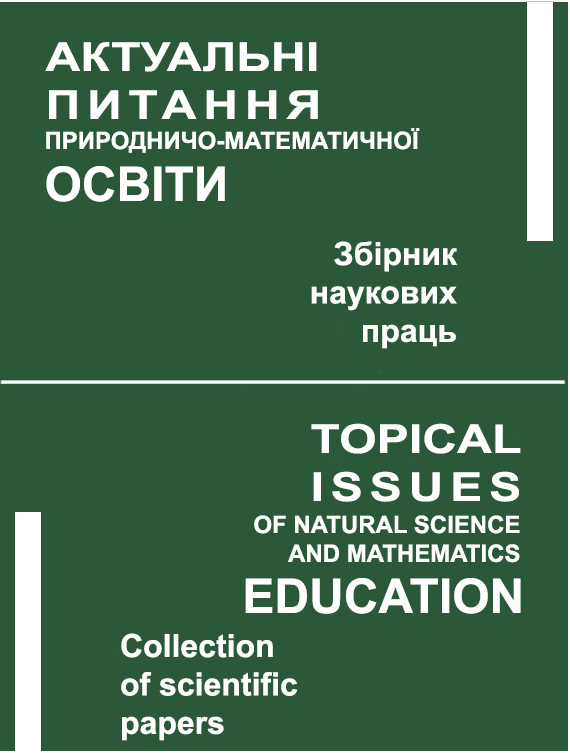
Збірник наукових праць
АКТУАЛЬНІ ПИТАННЯ ПРИРОДНИЧО-МАТЕМАТИЧНОЇ ОСВІТИ
The Collection of Scientific Papers
TOPICAL ISSUES OF NATURAL SCIENCE AND MATHEMATICS EDUCATION
Збірник наукових праць «Актуальні питання природничо-математичної освіти» (ISSN: 2519-2361) включено до Переліку наукових фахових видань України (Категорія «Б») відповідно до наказу МОН № 1471 від 26.11.2020 року. Збірник «Актуальні питання природничо-математичної освіти (ISSN: 2519-2361)» індексується у базах Google Scholar та Index Copernicus. Значення показника Index Copernicus Value (ICV):
ICV 2024 = 86.25
ICV 2023 = 89.85
ICV 2022 = 87.92
ICV 2020 = 84.67
ICV 2019 = 80.39
ICV 2018 = 64.79
Кожній статті журналу присвоюється DOI – міжнародний цифровий ідентифікатор об’єкта (ЦІО), англ. Digital object identifier (DOI).
_________________________________
The Collection of Scientific Papers "TOPICAL ISSUES OF NATURAL SCIENCE AND MATHEMATICS EDUCATION" (ISSN: 2519-2361) is in the List of specialized scientific publications (of scientific professional editions) of Ukraine (category "B") in accordance with the order of the Ministry of Education and Science No. 1471 of 26.11.2020. Collection "TOPICAL ISSUES OF NATURAL SCIENCE AND MATHEMATICS EDUCATION (ISSN: 2519-2361)" is indexed in Google Scholar and Index Copernicus. Index Copernicus Value (ICV):
ICV 2024 = 86.25
ICV 2023 = 89.85
ICV 2022 = 87.92
ICV 2020 = 84.67
ICV 2019 = 80.39
ICV 2018 = 64.79
Every article of this digest is given Digital object identifier (DOI).
Збірник наукових праць «Актуальні питання природничо-математичної освіти» включено до переліку наукових фахових видань України відповідно до наказу МОН України № 1604 від 22.12.16 року.
Збірник наукових праць «Актуальні питання природничо-математичної освіти» включено до Переліку наукових фахових видань України (Категорія «Б») відповідно до наказу МОН № 1471 від 26.11.2020 року.
Вперше збірник наукових праць було включено до переліку наукових фахових видань України відповідно до наказу МОН України № 1604 від 22.12.2016 року.
Мета наукового видання «Актуальні питання природничо‑математичної освіти» – поширювати та систематизувати наукові, науково‑методичні та практичні результати досліджень у сфері методики навчання предметів природничо‑математичного циклу, сприяти підвищенню якості освіти та професійному розвитку здобувачів освіти, педагогічних, науково-педагогічних та наукових працівників.
Завдання:
Публікація досліджень
Публікація наукових, науково‑методичних, практичних та науково‑дослідних статей з актуальних питань предметів природничо‑математичного циклу та методик їх навчання.
Підвищення якості навчання
Обговорення та пропозиції шляхів підвищення якості навчання природничо‑математичних дисциплін у закладах освіти усіх рівнів акредитації.
Розвиток творчої особистості
Поширення досвіду формування інтелектуальних умінь і творчих здібностей здобувачів освіти у процесі вивчення природничо‑математичних дисциплін, у тому числі з опорою на психолого‑педагогічний супровід.
Підготовка та підвищення кваліфікації вчителів
Сприяння удосконаленню системи підготовки вчителів природничо‑математичного циклу, підтримання їхнього професійного зростання та методичної компетентності.
Інтеграція цифрових інформаційних технологій
Пропагування використання цифрових інформаційних технологій, ІКТ‑засобів та цифрових навчальних ресурсів для оптимізації навчання природничо‑математичних дисциплін.
Формування наукового середовища
Об’єднання науковців‑педагогів, вчителів‑практиків та аспірантів у єдине наукове середовище для обміну досвідом, обговорення сучасних проблем та впровадження інноваційних підходів у сфері природничо‑математичної освіти.
Key-title: Aktualʹnì pitannâ prirodničo-matematičnoï osvìti
ISSN 2519-2361
Мова видання: українська, англійська.
Періодичність: 2 випусків на рік.
Рік заснування: 2012.
Засновник: Сумський державний педагогічний університет імені А.С. Макаренка, м. Суми, Україна.
ЄДРПОУ: 02125510.
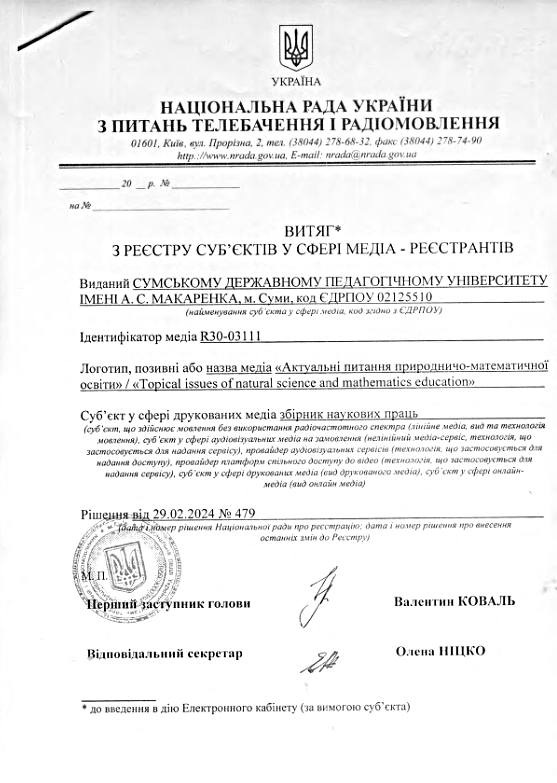
Реєстрація суб'єкта у сфері друкованих медіа: Рішення Національної ради України з питань телебачення і радіомовлення № 479 від 29.02.2024 року
Ідентифікатор медіа: R30-03111
Реєстр дослідницьких організацій (ROR ID): 020kwj692
DOI: https://doi.org/10.24139/2519-2361
Електронна пошта: appmo@sspu.edu.ua
Кластер (науковий профіль видання): «Розвиток людського капіталу, соціальні науки та журналістика».
Спеціальності: А3 Початкова освіта, А4 Середня освіта (математика, фізика, біологія, хімія), А5 Професійна освіта (математика, фізика, біологія, хімія)
Наказом МОН України № 26.11.2020 № 1471 друковане періодичне видання «Актуальні питання природничо-математичної освіти» включено до Переліку наукових фахових видань України категорії «Б» у галузі педагогічних наук за спеціальностями 011 Освітні науки, 012 Дошкільна освіта, 013 Початкова освіта, 014 Середня освіта, 015 Професійна освіта.
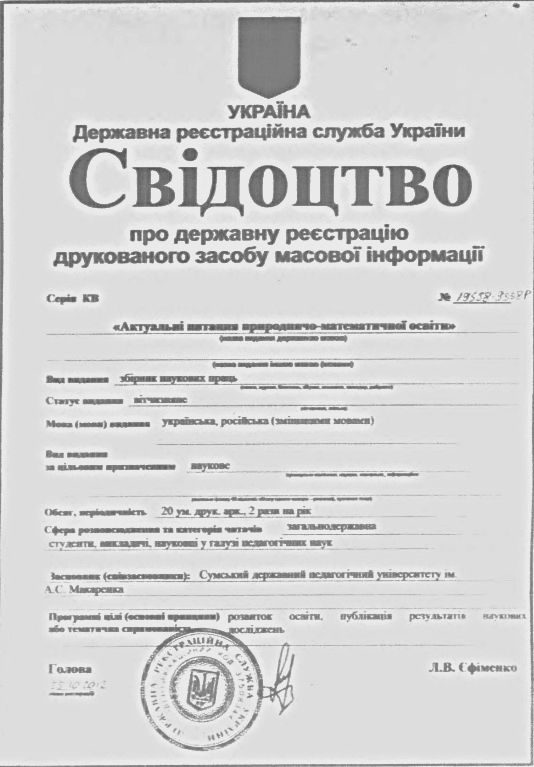
тановчі документи
 _________________________________
The collection of scientific works “TOPICAL ISSUES OF NATURAL SCIENCE AND MATHEMATICS EDUCATION” has been included in the List of Scientific Professional Publications of Ukraine (Category “B”) in accordance with Order No. 1471 of the Ministry of Education and Science of Ukraine dated November 26, 2020.
The collection of scientific works was first included in the list of scientific professional publications of Ukraine in accordance with Order No. 1604 of the Ministry of Education and Science of Ukraine dated December 22, 2016.
The collection of scientific works “TOPICAL ISSUES OF NATURAL SCIENCE AND MATHEMATICS EDUCATION” is to disseminate and systematize scientific, pedagogical, and practical research findings in the field of teaching methods for science and mathematics subjects, and to contribute to improving the quality of education and the professional development of students, teachers, educational researchers, and scientists.
Objectives:
Publication of research
Publication of scientific, scientific-methodological, practical, and research articles on current issues in natural science and mathematics subjects and their teaching methodologies.
Improving the quality of education
Discussion and proposals for ways to improve the quality of education in natural science and mathematics disciplines in educational institutions at all levels of accreditation.
Development of creative personalities
Sharing experiences in fostering intellectual skills and creative abilities among students in the process of studying natural science and mathematics disciplines, including through psychological and pedagogical support.
Teacher Training and Professional Development
Promoting the improvement of the teacher training system for science and mathematics, and supporting teachers’ professional growth and pedagogical competence.
Integration of Digital Information Technologies
Promoting the use of digital information technologies, ICT tools, and digital educational resources to optimize the teaching of natural science and mathematics disciplines.
Building a scientific community
Bringing together researchers, practicing teachers, and graduate students into a unified scientific community to exchange experiences, discuss current issues, and implement innovative approaches in science and mathematics education.
Key-title: Aktualʹnì pitannâ prirodničo-matematičnoï osvìti
ISSN 2519-2361
Language of publication: Ukrainian, English.
Frequency: 2 issues per year.
Year of foundation: 2012.
Founder: Sumy State Pedagogical University named after A.S. Makarenko, Sumy, Ukraine.
EDRPOU: 02125510
Registration of the entity in the field of print media: Decision of the National Council of Ukraine on Television and Radio Broadcasting No. 479 of 29.02.2024.
Media identifier: R30-03111
Register of Research Organizations (ROR ID): 020kwj692
DOI: https://doi.org/10.24139/2519-2361
E-mail: appmo@sspu.edu.ua
Cluster (scientific profile of the publication): “Human capital development, social sciences, and journalism.”
Specialties: A3 Primary education, A4 Secondary education (mathematics, physics, biology, chemistry), A5 Vocational education (mathematics, physics, biology, chemistry)
By order of the Ministry of Education and Science of Ukraine No. 26.11.2020 No. 1471, the printed periodical “Current Issues of Natural Science and Mathematics Education” was included in the List of Scientific Professional Publications of Ukraine of Category “B” in the field of pedagogical sciences in the specialties 011 Educational Sciences, 012 Preschool Education, 013 Primary Education, 014 Secondary Education, 015 Vocational Education.
Видання здійснюється із залученням авторських коштів.
Кожній статті збірника присвоюється DOI – міжнародний цифровий ідентифікатор об’єкта (ЦІО), англ. Digital object identifier (DOI) – серійний номер, що використовується для постійної та унікальної ідентифікації об’єктів будь-якого типу. DOI використовується для «сталої ідентифікації зразків інтелектуальної власності в цифровій мережі та асоціювання структурованих даних в розширюваний спосіб»).
Наукові статті, що подаються до друку, повинні бути написані українською чи англійською мовою та містити матеріал, не опублікований раніше. Відповідно до вимог ВАК України (Постанова № 7-06 від 15 січня 2003 р.) необхідно дотримуватися таких елементів написання статей: постановка проблеми у загальному вигляді та її зв'язок із важливими науковими чи практичними завданнями; аналіз основних досліджень і публікацій, в яких започатковано розв'язання даної проблеми і на які спирається автор, виділення невирішених раніше частин загальної проблеми, яким присвячується означена стаття; формулювання цілей статті (постановка завдання); виклад основного матеріалу дослідження з повним обґрунтуванням отриманих наукових результатів; висновки з даного дослідження і перспективи подальших розвідок у даному напрямку. З метою дотримання зазначених вище вимог до наукової статті слід жирним шрифтом виділити такі елементи статті:
– постановка проблеми;
– аналіз актуальних досліджень;
– мета статті;
– виклад основного матеріалу;
– висновки та перспективи подальших наукових розвідок.
Обсяг статті, включно зі списком цитованої літератури (8-14 джерел), повинен становити 7-10 сторінок формату А4. Шрифт – Times New Roman. Відстань між рядками –1,15 інтервали комп'ютерного стандарту, кегель 12; поля: 25 мм з усіх берегів.
Сторінки рукопису не нумеруються.
Комп’ютерний переклад не допускається.
При поданні статті до друку авторам слід дотримуватися таких вимог:
не здійснювати ущільнення або розрідження інтервалів між літерами;
не відбивати абзаци табуляціями або багаторазовими пробілами;
використовувати лапки формату « »;
між ініціалами та прізвищем ставити нерозривний пробіл (Ctrl+Shift+пробіл);
використовувати лише графічні елементи, виконані у графічних редакторах із високою якістю деталей;
використовувати формат файлу для відправки в редакцію.
Кількість авторів однієї публікації не повинна перевищувати трьох осіб.
Рукопис оформляється згідно з Держстандартом ДСТУ 3008-95. У верхньому лівому куті першої сторінки рукопису ставиться УДК, у правому – ініціали та прізвище автора (авторів), ORCID ID автора (реєстрація ORCID ID здійснюється на сайті orcid.org), назва закладу.
Нижче посередині рядка – заголовок статті великими літерами (жирним шрифтом).
Нижче, через порожній рядок – анотація українською мовою (обсягом 1800-2000 знаків), ключові слова (8-10 курсивом).
Нижче, через порожній рядок, подається текст статті.
Через порожній рядок – список використаних джерел.
Після списку використаних джерел – анотація англійською мовою (обсягом не менш як 1800-2000 знаків), ключові слова (8-10 курсивом). Над анотацією потрібно зазначити прізвище та ініціали автора (авторів), назву статті англійською мовою.
В анотаціях необхідно відобразити такі елементи: мета статті, методи дослідження, результати дослідження, практичне значення дослідження, висновки та перспективи подальших наукових розвідок.
Підписи до рисунків, схем, таблиць включають їх номер, назву, пояснення умовних позначень.
Посилання на джерела в тексті подаються за таким зразком: [5, c. 87], де 5 – номер джерела за списком літератури, 87 – сторінка. Посилання на декілька наукових видань одночасно подаються таким чином: [3, c. 156; 4; 8, c. 22-23].
Бібліографічний список складається через 1 інтервал, кегль 12, в алфавітному порядку і подається після тексту статті під заголовком: «Список використаних джерел». Він має бути оформлений згідно з вимогами стандарту АРА (http://www.apastyle.org), де всі кириличні назви джерел перекладаються англійською мовою.
З метою підвищення індексу цитованості слід подавати переклад статей/книг/авторефератів дисертацій англійською мовою в авторській редакції, що міститься в анотації до цієї наукової роботи.
Працюючи над статтею та створюючи бібліографічний список, просимо звертати увагу на україномовні та іншомовні джерела, максимально враховуючи звернення НАЗЯВО від 24.01.2023 року та стратегію популяризації української мови до 2030 року “Сильна мова – успішна держава”, схваленої розпорядженням Кабінету Міністрів України від 17 липня 2019 р. № 596, щодо утвердження всебічного використання української мови в усіх сферах (зокрема освітній і науковій) на всій території України.
Стаття має бути ретельно перевірена й повністю відредагована. Матеріали, в яких допущені будь-які помилки, до друку не допускаються.
За зміст публікацій та достовірність викладення матеріалів несе відповідальність автор.
До статті додаються:
1. Довідка про авторів (у окремому файлі): прізвище, ім'я, по батькові, місце роботи, посада, науковий ступінь, вчене звання, домашня адреса / адреса для листування (адреса електронної пошти), адреса для відправки збірника (відділення «Нової пошти»), контактні телефони.
2. Відгук-рекомендація наукового керівника (для аспірантів і здобувачів, що подають одноосібні статті) додається окремим файлом (лаконічно зазначається новизна, особистий внесок автора, рекомендація до друку).
Текст статті та довідка про авторів надсилаються на електронну пошту збірника appmo@sspu.edu.ua
Рішення про публікацію ухвалюється після рецензування статті членами редколегії або запрошеними фахівцями.
Для досягнення більшої об’єктивності оцінки наукового змісту статей проводиться незалежне, конфіденційне рецензування (без зазначення прізвищ авторів і рецензентів).
Відхилені рукописи авторам не повертають.
Після публікації наукового журналу електронні версії статей будуть розміщені у відкритому доступі на сайті збірника у розділі «Архив номерів»: https://fizmat.sspu.edu.ua/component/sppagebuilder/?view=page&id=178
Зразок оформлення статті
УДК 371.315.6:51 Г. П. Шевченко
ORCID ID 0000-0003-0895-3476
Сумський державний педагогічний
університет імені А. С. Макаренка
(порожній рядок)
ЗАГОЛОВОК СТАТТІ
(порожній рядок)
Анотація українською мовою, не менше 1800-2000 друкованих знаків через 1 інтервал, кегль 12, курсивом.
Ключові слова: 8-10 – курсив.
(порожній рядок)
Текст статті.
(порожній рядок)
СПИСОК ВИКОРИСТАНИХ ДЖЕРЕЛ / REFERENCES
1. Лавриченко, Н. М. (2016). Теоретична модель розвитку обдарованості й таланту за авторством Ф. Ганє. Вісник Глухівського національного педагогічного університету імені Олександра Довженка, 32, 69–75.
2. Heller, K. A. (1989). Perspectives on the diagnosis of giftedness. German journal of psychology, 13, 140–159.
(порожній рядок)
Shevchenko G.P. Title of article.
Summary. Англійською мовою. Обсягом 1800-2000 друкованих знаків через 1 інтервал, кегль 12, курсивом.
Key words: 8-10.
Приклад оформлення списку використаних джерел за стандартом АРА
СПИСОК ВИКОРИСТАНИХ ДЖЕРЕЛ / REFERENCES
Законодавчий акт
1. Jacob K. Javits Gifted and Talented Students Education Act. Title IV, Part B of P.L. (1998).
2. Закон України «Про основні засади державної підтримки обдарованих дітей та молоді на Україні» (Law of Ukraine “On the main foundations of gifted children and youth support in Ukraine”) (2005). Retrieved from: http://www.zakon.rada.gov.ua/
Дисертація/автореферат дисертації
1. Бобир, О. В. (2005). Особистісні характеристики юнацтва з різними формами обдарованості (дис. … канд. психол. наук: 19.00.07). Дніпропетровськ (Bobyr, O. V. Personal characteristics of adolescents with different forms of giftedness (PhD thesis). Dnipropetrovsk).
2. Коваленко, О. А. (2011). Теоретичні і методичні основи навчання академічно обдарованих учнів початкової школи (автореф. дис. ... д-ра пед. наук: 13.00.09). Кривий Ріг. (Kovalenko, O. A. (2011). Theoretical and methodological foundations of teaching academically gifted pupils in primary schools (DSc thesis abstract). Kryvyi Rih).
Книга
1. Davis, G. A., Rimm, S. A. (2004). Education of the gifted and talented. Boston, MA: Allyn & Bacon.
Частина книги
1. Davidson, J. E. (1986). The role of insight in giftedness. In R. J. Sternberg, J. E. Davidson (Eds), Conceptions of giftedness (pp. 201–222). New York: Cambridge University Press.
2. Haensly, P. Reynolds, C. R., Nash, W. R. (1986). Giftedness: coalescence, context, conflict, and commitment. In R. J. Sternberg, J. E. Davidson (Eds), Conceptions of giftedness (pp. 128–148). New York: Cambridge University Press.
3. Корольов, Д. К. (2014). Теоретичні засади дослідження освітнього середовища для обдарованих дітей та молоді в зарубіжній науці. Освітнє середовище як чинник становлення обдарованої особистості, Р. О. Семенова (ред.), (сс. 9–22). К.-Кіровоград: Імекс-ЛТД (Korolov, D. K. (2014). Theoretical framework of the research of educational environment for gifted children and youth in a foreign science. In R. O. Semenova (Ed.), Educational environment as a factor of the gifted person formation (pp. 9–22). K.-Kirovohra: Imeks-LTD).
Стаття
1. Heller, K. A. (1989). Perspectives on the diagnosis of giftedness. German journal of psychology, 13, 140–159.
2. Лавриченко, Н. М. (2016). Теоретична модель розвитку обдарованості й таланту за авторством Ф. Ганє. Вісник Глухівського національного педагогічного університету імені Олександра Довженка, 32, 69–75. (Lavrychenko, N. M. (2016). The theoretical model of giftedness and talent by F. Gagné authorship. Olexandr Dovzhenko Hlukhiv National Pedagogical University Bulletin, 32, 69– 75).
Електронний ресурс
1. STEM Rankings Best High Schools. U.S. News Rankings. Retrieved from: http://www.usnews.com/education/best-high-schools/national-rankings/stem/.
2. Мала академія наук України. Про МАН. Режим доступу: http://man.gov.ua/ua/about_the_academy/macsu (Minor Academy of Sciences of Ukraine. About MAS. Retrieved from: http://man.gov.ua/ua/about_the_academy/macsu).
_______________________________
The collection is published with funding from the authors.
Each article in the collection is assigned a DOI – an international Digital Object Identifier (DOI) – a serial number used for the permanent and unique identification of objects of any type. A DOI is used for “the persistent identification of intellectual property items in a digital network and the association of structured data in an extensible manner.”
Scientific articles submitted for publication must be written in Ukrainian or English and contain material that has not been previously published. In accordance with the requirements of the Higher Attestation Commission of Ukraine (Resolution No. 7-06 of January 15, 2003), the following elements must be observed when writing articles: a general formulation of the problem and its connection to important scientific or practical tasks; an analysis of key studies and publications that initiated the resolution of this problem and on which the author relies, highlighting previously unresolved aspects of the general problem addressed in this article; formulation of the article’s objectives (statement of the problem); presentation of the main research material with a full justification of the scientific results obtained; conclusions from this study and prospects for further research in this area. To comply with the above requirements for a scientific article, the following elements of the article should be highlighted in bold:
– statement of the problem;
– analysis of current research;
– purpose of the article;
– presentation of the main material;
– conclusions and prospects for further research.
The length of the article, including the list of references (8–14 sources), should be 7–10 A4 pages. Font: Times New Roman. Line spacing: 1.15 standard computer spacing, font size 12; margins: 25 mm on all sides.
The pages of the manuscript are not numbered.
Computer-generated formatting is not permitted.
When submitting an article for publication, authors must adhere to the following requirements:
• do not compress or expand the spacing between letters;
• do not indent paragraphs with tabs or multiple spaces;
• use quotation marks in the format “ ”;
• insert a non-breaking space (Ctrl+Shift+Space) between initials and the last name;
• use only graphic elements created in graphic editors with high-quality detail;
• use the file format specified for submission to the editorial office.
The number of authors for a single publication should not exceed three.
The manuscript must be formatted in accordance with the State Standard DSTU 3008-95. In the upper left corner of the first page of the manuscript, the UDC code is placed; in the right corner – the initials and last name of the author(s), the author’s ORCID ID (ORCID ID registration is carried out on the website orcid.org), and the name of the institution.
Below, centered on the line – the title of the article in capital letters (bold font).
Below, after a blank line, the abstract in Ukrainian (1,800–2,000 characters) and keywords (8–10 in italics) are provided.
Below, after a blank line, the text of the article is presented.
After a blank line, the list of references is provided.
Following the list of references, include an abstract in English (at least 1,800–2,000 characters) and keywords (8–10, in italics). Above the abstract, indicate the last name and initials of the author(s) and the title of the article in English.
Abstracts must include the following elements: the purpose of the article, research methods, research results, practical significance of the research, conclusions, and prospects for further scientific research.
Captions for figures, diagrams, and tables should include their number, title, and an explanation of symbols.
References to sources in the text are formatted as follows: [5, p. 87], where 5 is the source number in the reference list, and 87 is the page number. References to multiple scientific publications are listed as follows: [3, p. 156; 4; 8, pp. 22–23].
The bibliography is formatted with single spacing, 12-point font, in alphabetical order, and is presented after the text of the article under the heading: “List of References.” It must be formatted in accordance with the http://www.apastyle.org (APA) style, where all Cyrillic titles of sources are translated into English.
When working on an article and compiling a bibliography, please pay attention to Ukrainian-language and foreign-language sources, taking into account as much as possible the appeal of the National Agency for Higher Education Quality Assurance (NAZYAO) dated January 24, 2023, and the strategy for the promotion of the Ukrainian language until 2030, “A Strong Language – A Successful State,” approved by Order of the Cabinet of Ministers of Ukraine No. 596 dated July 17, 2019, regarding the promotion of the comprehensive use of the Ukrainian language in all spheres (particularly in education and science) throughout the territory of Ukraine.
The article must be thoroughly reviewed and fully edited. Materials containing any errors will not be accepted for publication.
The author is responsible for the content of the publications and the accuracy of the presented materials.
The following must be included with the article:
1. Author information (in a separate file): last name, first name, patronymic, place of employment, position, academic degree, academic title, home address / mailing address (email address), address for sending the collection (Nova Poshta branch), contact phone numbers.
2. A review-recommendation from the academic advisor (for graduate students and candidates submitting individual articles) is attached as a separate file (briefly noting the novelty, the author’s personal contribution, and a recommendation for publication).
The text of the article and the author information sheet should be sent to the journal’s email address: appmo@sspu.edu.ua
The decision to publish is made after the article has been reviewed by members of the editorial board or invited experts.
To ensure greater objectivity in the evaluation of the scientific content of articles, an independent, confidential review process is conducted (without disclosing the names of the authors or reviewers).
Rejected manuscripts will not be returned to the authors.
Following publication in the journal, electronic versions of the articles will be made available in open access on the journal’s website under the “Issue Archive” section: https://fizmat.sspu.edu.ua/component/sppagebuilder/?view=page&id=178
Sample Article Format
UDC 371.315.6:51 G. P. Shevchenko
ORCID ID 0000-0003-0895-3476
Sumy State Pedagogical
University named after A. S. Makarenko
(blank line)
ARTICLE TITLE
(blank line)
Abstract, no less than 1,800–2,000 printed characters, single-spaced, 12-point font, italics.
Keywords: 8–10 – italics.
(blank line)
Article text.
(blank line)
REFERENCES
1. Lavrychenko, N. M. (2016). F. Gane’s theoretical model of the development of giftedness and talent. Bulletin of the Oleksandr Dovzhenko Hlukhiv National Pedagogical University, 32, 69–75.
2. Heller, K. A. (1989). Perspectives on the diagnosis of giftedness. German Journal of Psychology, 13, 140–159.
Example of how to format REFERENCES
Legislative Act
1. Jacob K. Javits Gifted and Talented Students Education Act. Title IV, Part B of P.L. (1998).
2. Law of Ukraine “On the main foundations of gifted children and youth support in Ukraine” (2005). Retrieved from: http://www.zakon.rada.gov.ua/
Dissertation/abstract of the dissertation
1. Bobyr, O. V. Personal characteristics of adolescents with different forms of giftedness (PhD thesis). Dnipropetrovsk.
2. Kovalenko, O. A. (2011). Theoretical and methodological foundations of teaching academically gifted pupils in primary schools (DSc thesis abstract). Kryvyi Rih.
Book
1. Davis, G. A., Rimm, S. A. (2004). Education of the gifted and talented. Boston, MA: Allyn & Bacon.
Part of the book
1. Davidson, J. E. (1986). The role of insight in giftedness. In R. J. Sternberg, J. E. Davidson (Eds), Conceptions of giftedness (pp. 201–222). New York: Cambridge University Press.
2. Haensly, P. Reynolds, C. R., Nash, W. R. (1986). Giftedness: coalescence, context, conflict, and commitment. In R. J. Sternberg, J. E. Davidson (Eds), Conceptions of giftedness (pp. 128–148). New York: Cambridge University Press.
3. Korolov, D. K. (2014). Theoretical framework of the research of educational environment for gifted children and youth in a foreign science. In R. O. Semenova (Ed.), Educational environment as a factor of the gifted person formation (pp. 9–22). K.-Kirovohra: Imeks-LTD.
Article
1. Heller, K. A. (1989). Perspectives on the diagnosis of giftedness. German journal of psychology, 13, 140–159.
2. Lavrychenko, N. M. (2016). The theoretical model of giftedness and talent by F. Gagné authorship. Olexandr Dovzhenko Hlukhiv National Pedagogical University Bulletin, 32, 69– 75.
Online resource
1. STEM Rankings Best High Schools. U.S. News Rankings. Retrieved from: http://www.usnews.com/education/best-high-schools/national-rankings/stem/.
2. Minor Academy of Sciences of Ukraine. About MAS. Retrieved from: http://man.gov.ua/ua/about_the_academy/macsu.
Редакційна колегія збірника наукових праць «Актуальні питання природничо-математичної освіти» застосовує процедуру розгляду скарг щодо порушень академічної доброчесності та публікаційної етики відповідно до рекомендацій COPE (Core Practices). Процедура є прозорою, об’єктивною та конфіденційною, з фіксацією всіх етапів.
Етапи розгляду скарг
1. Подання скарги: Звернення надсилається на email редакції (appmo@sspu.edu.ua) з вказівкою ПІБ заявника, контактів, суті порушення (плагіат, фабрикація даних, конфлікт інтересів тощо), посилання на публікацію та доказів. Анонімні скарги розглядаються за наявності достатньої доказової бази.
2. Первинний розгляд: Головний редактор або уповноважений член колегії реєструє скаргу та перевіряє її на компетентність протягом 5–14 днів, виключаючи конфлікти інтересів.
3. Формування комісії: Призначається незалежна комісія (3–5 осіб з редакції, експертів чи зовнішніх фахівців) для розслідування, включаючи перевірку на плагіат.
4. Розслідування: Збір доказів, запит коментарів від сторін (авторів, рецензентів), аналіз протягом 4 тижнів. Сторони інформуються про хід.
Можливі рішення та наслідки
Рішення | Наслідки |
Необґрунтована скарга | Відхилення, повідомлення заявнику |
Підтверджене порушення | Виправлення, спростування, ретракція статті, заборона публікацій для порушника, інформування установи роботодавця |
Серйозне порушення | Публікація повідомлення про ретракцію з DOI, повідомлення індексаторів (Google Scholar) |
Рішення комісії остаточне, з правом апеляції до COPE. Процедура фіксується в журналі.
__________________________________
The editorial board of the journal Current Issues in Natural Sciences and Mathematics Education follows a procedure for handling complaints regarding violations of academic integrity and publication ethics in accordance with COPE (Core Practices) guidelines. The procedure is transparent, objective, and confidential, with all stages documented.
Stages of Complaint Review
1. Filing a Complaint: The complaint is sent to the editorial office’s email address (fizmat@sspu.edu.ua), including the complainant’s full name, contact information, the nature of the violation (plagiarism, data fabrication, conflict of interest, etc.), a link to the publication, and supporting evidence. Anonymous complaints are considered if there is sufficient evidence.
2. Initial review: The editor-in-chief or an authorized member of the editorial board registers the complaint and reviews it for validity within 5–14 days, ruling out any conflicts of interest.
3. Formation of a committee: An independent committee (comprising 3–5 members from the editorial board, experts, or external specialists) is appointed to conduct an investigation, including a plagiarism check.
4. Investigation: Gathering evidence, requesting comments from the parties (authors, reviewers), and conducting an analysis over a period of 4 weeks. The parties are kept informed of the progress.
Possible decisions and consequences
Decision | Consequences |
Unfounded complaint | Rejection, notification to the applicant |
Confirmed violation | Corrections, retractions, removal of articles, publication bans for offenders, notification of the employer |
Serious violation | Publication of a retraction notice with a DOI, notification to indexing services (Google Scholar) |
The commission's decision is final, with the right to appeal to COPE. The proceedings are recorded in the minutes.
Політика використання ШІ та технологій з підтримкою ШІ
Рекційна колегія збірника визнає, що штучний інтелект (ШІ) та інструменти, що ним базуються (переважно генеративні Chat‑моделі, інструменти для редагування, технічного аналізу даних, створення графіків тощо), можуть бути корисними допоміжними засобами для авторів на етапах підготовки та оформлення наукових публікацій. Разом із тим, використання ШІ повинно відбуватися в межах академічної доброчесності, наукової відповідальності, прозорості та відповідно до міжнародних стандартів публікаційної етики.
Допустимі сфери застосування ШІ
Допустимими вважаються ситуації, коли ШІ використовується як технічний або редакційний інструмент при наявності відповідального авторського внеску, зокрема:
· допомога у підготовці та редагуванні тексту (покращення мовного стилю, корекція граматики, структурування розділів, переклад термінів);
· технічна обробка даних (форматування таблиць, статистичні обчислення, візуалізація результатів, підбір графічних елементів) за умови, що аналіз, інтерпретація та висновки залишаються авторськими;
· допоміжні пошукові або інформаційні функції (формування чернеток анотацій, списків літератури, пошук джерел, генерація ідей для структури статті), якщо їхню наукову цінність та достовірність автор перевіряє та ретельно редагує.
Недопустимі сфери застосування ШІ
Категорично недопустимим вважається використання ШІ, якщо воно може поставити під сумнів оригінальність, достовірність та наукову значущість роботи, зокрема:
· створення або генерація основного наукового тексту без глибокого авторського перероблення, перевірки джерел, фактичної та логічної перевірки;
· фабрикація, фальсифікація або спотворення експериментальних даних, результатів, посилань на літературу чи висновків;
· автоматичне генерування «вигаданих» досліджень, експериментів, моделей, які фактично не проводились і не аналізувались автором;
· використання ШІ для уникання плагіатного переписування мовного та/або смислового змісту інших публікацій;
· викладення генеративних ШІ‑текстів як результатів авторських розумових дій, без чіткого відокремлення власного внеску автора.
Вимоги до розкриття інформації про використання ШІ
Для забезпечення прозорості та довіри до результатів редакція вимагає від авторів у разі будь‑якого використання ШІ (навіть на рівні чернетки, перекладу чи редагування) вказати: назву/назву сервісу або інструменту ШІ; версію (за наявності); сферу застосування (наприклад: «редагування українського тексту», «переклад англійської версії анотації», «форматування таблиць», «допоміжна візуалізація даних»); короткий опис того, як автор використовував ШІ та які частини тексту/даних були змінені або сформовані.
ШІ не може бути вказаний як автор, співавтор або експерт, оскільки відповідальність за зміст, достовірність та відповідність стандартам етики несуть фізичні особи‑автори.
___________________________________
Policy on the Use of AI and AI-Powered Technologies
The journal recognizes that artificial intelligence (AI) and AI-based tools (primarily generative chat models, tools for editing, technical data analysis, graph creation, etc.) can be useful aids for authors during the preparation and formatting of scientific publications. However, the use of AI must occur within the bounds of academic integrity, scientific responsibility, transparency, and in accordance with international standards of publication ethics.
Permissible Uses of AI
The following situations are considered permissible when AI is used as a technical or editorial tool, provided there is a responsible authorial contribution:
• assistance in preparing and editing text (improving writing style, correcting grammar, structuring sections, translating terms);
• technical data processing (formatting tables, statistical calculations, visualizing results, selecting graphic elements), provided that the analysis, interpretation, and conclusions remain the author’s own;
• supporting research or informational functions (drafting abstracts, bibliographies, searching for sources, generating ideas for the article’s structure), provided that the author verifies and carefully edits their scientific value and accuracy.
Prohibited Uses of AI
The use of AI is strictly prohibited if it could call into question the originality, authenticity, and scientific significance of the work, specifically:
• the creation or generation of the main scientific text without substantial authorial revision, verification of sources, and factual and logical verification;
• fabrication, falsification, or distortion of experimental data, results, references to the literature, or conclusions;
• automatic generation of “fictitious” studies, experiments, or models that were not actually conducted or analyzed by the author;
• using AI to avoid plagiaristic rewriting of the linguistic and/or semantic content of other publications;
• presenting AI-generated texts as the results of the author’s own intellectual work, without clearly distinguishing the author’s own contribution.
Requirements for Disclosing the Use of AI
To ensure transparency and trust in the results, the editorial board requires authors to disclose the following whenever AI is used (even at the draft, translation, or editing stage): the name of the AI service or tool; the version (if available); the scope of application (e.g., “editing of the Ukrainian text,” “translation of the English abstract,” “table formatting,” “auxiliary data visualization”); a brief description of how the author used AI and which parts of the text/data were modified or generated.
AI cannot be listed as an author, co-author, or expert, as individual authors bear responsibility for the content, accuracy, and compliance with ethical standards.
Порядок відкликання опублікованих статей
1. Визначення та підстави для відкликання
Відкликання статті — це адміністративна дія редакції збірника, що полягає у вилученні опублікованої статті з наукового обігу з одночасним збереженням її метаданих у базі даних. Відкликана стаття позначається поміткою «Відкликано», але залишається доступною для цитування з поясненням причин.
Підстави для відкликання:
Плагіат (включно з автоплагіатом) або дублювання публікацій.
Фальсифікація даних, маніпуляція зображеннями чи результатами досліджень.
Значні методологічні помилки, що роблять висновки недійсними.
Порушення етичних норм (конфлікт інтересів, відсутність згоди на дослідження з людьми/тваринами).
Неправомірне авторство (додавання/видалення авторів без згоди).
Множинна публікація тієї ж статті в інших виданнях.
Виявлення, що стаття є частиною скоординованих маніпуляцій (наприклад, "паперові млини").
Відкликання не застосовується до незначних помилок (використовуються коректування).
2. Процедура відкликання
1. Отримання скарги або виявлення проблеми: редакція отримує скаргу від авторів, читачів, рецензентів, установ чи виявляє проблему самостійно.
2. Попереднє розслідування: головний редактор призначає редакційну комісію (3–5 осіб, включаючи незалежних експертів). Термін: до 30 днів. Авторам надсилається повідомлення з вимогою пояснень (термін відповіді: 10 днів).
3. Рішення комісії: на основі доказів комісія рекомендує відкликання, коректування чи відмову. Рішення затверджує редакційна колегія.
4. Повідомлення сторін: авторам, установам, індексуючим базам (Google Scholar) та попереднім рецензентам надсилається офіційний лист з поясненням.
5. Публікація нотифікації: на сайті журналу публікується «Рішення про відкликання» з DOI, текстом пояснення, датою та підписом редактора. Стаття блокується, але архівується.
6. Оновлення метаданих: Crossref та інші бази повідомляються для оновлення статусу.
Термін повної процедури: до 60 днів з моменту виявлення.
3. Відповідальність
У разі відкликання автори виключаються з подальшої співпраці з журналом (до 5 років).
Журнал не несе відповідальності за цитування відкликаних статей до моменту нотифікації.
4. Апеляція
Автори можуть оскаржити рішення протягом 30 днів, подавши обґрунтовані докази на email редакції appmo@sspu.edu.ua. Апеляційна комісія (незалежна від попередньої) розглядає скаргу за 30 днів.
___________________________________
Procedure for Retracting Published Articles
1. Definition and Grounds for Retraction
The retraction of an article is an administrative action taken by the journal’s editorial board, consisting of the removal of a published article from academic circulation while retaining its metadata in the database. A retracted article is marked as “Retracted” but remains available for citation with an explanation of the reasons.
Grounds for retraction:
• Plagiarism (including self-plagiarism) or duplicate publication.
• Data fabrication, manipulation of images, or research results.
• Significant methodological errors that invalidate the conclusions.
• Violations of ethical standards (conflict of interest, lack of consent for research involving humans/animals).
• Unauthorized authorship (adding/removing authors without consent).
• Multiple publication of the same article in other journals.
• Discovery that the article is part of coordinated manipulation (e.g., “paper mills”).
Retraction does not apply to minor errors (corrections are used instead).
2. Recall Procedure
1. Receipt of a complaint or identification of a problem: The editorial board receives a complaint from authors, readers, reviewers, or institutions, or identifies a problem on its own.
2. Preliminary investigation: The editor-in-chief appoints an editorial committee (3–5 members, including independent experts). Timeframe: up to 30 days. Authors are sent a notice requesting an explanation (response deadline: 10 days).
3. Committee decision: Based on the evidence, the committee recommends retraction, correction, or rejection. The decision is approved by the editorial board.
4. Notification of parties: An official letter with an explanation is sent to the authors, institutions, indexing databases (Google Scholar), and previous reviewers.
5. Publication of the notification: A “Retraction Decision” is published on the journal’s website with a DOI, the text of the explanation, the date, and the editor’s signature. The article is blocked but archived.
6. Metadata update: Crossref and other databases are notified to update the status.
Duration of the entire procedure: up to 60 days from the date of detection.
3. Liability
• In the event of retraction, authors will be barred from further collaboration with the journal (for up to 5 years).
• The journal assumes no liability for citations of retracted articles prior to notification.
4. Appeal
Authors may appeal the decision within 30 days by submitting substantiated evidence to the editorial email address appmo@sspu.edu.ua. An appeals committee (independent of the previous one) will review the appeal within 30 days.
Кошти на видання (друковану або електронну версію) надсилаються після повідомлення на електронну адресу автора про прийняття редколегією статті до друку протягом наступних 10 днів після отримання повідомлення.
Пересилка поштою (на відділення «Нової пошти») друкованих матеріалів здійснюється за рахунок автора.
Вартість присвоєння цифрового ідентифікатора об’єкта DOI – 100 грн
Оплата за друковане видання (для авторів, що подали статті українською мовою):
- друковане видання та електронна версія збірника (pdf-файл) – 650 грн. (для статті обсягом 7 сторінок);
– друковане видання та електронна версія збірника (pdf-файл) – 650 грн. + 90 грн за кожну сторінку статті, що перебільшують обсяг 7 сторінок;
– додатковий примірник друкованої версії (за потреби) – 520 грн
Оплата за друковане видання (для авторів, що подали статті англійською мовою):
- друковане видання та електронна версія збірника (pdf-файл) – 500 грн. (для статті обсягом 7 сторінок);
– друковане видання та електронна версія збірника (pdf-файл) – 500 грн. + 90 грн за кожну сторінку статті, що перебільшують обсяг 7 сторінок;
– додатковий примірник друкованої версії (за потреби) – 480 грн
Зарубіжні науковці мають можливість опублікувати свої праці безкоштовно за умови отримання лише електронної версії збірника.
Після публікації наукового журналу електронні версії збірника та статей будуть розміщені у відкритому доступі на сайті збірника
https://fizmat.sspu.edu.ua/component/sppagebuilder/?view=page&id=178
____________________________________
Payment for publication (print or electronic version) must be sent within 10 days of receiving notification via email that the editorial board has accepted the article for publication.
Postage for printed materials (to a “Nova Poshta” branch) is the responsibility of the author.
The cost of assigning a DOI (Digital Object Identifier) is 100 UAH.
Payment for the printed edition (for authors who submitted articles in Ukrainian):
- Printed edition and electronic version of the collection (PDF file) – 650 UAH (for a 7-page article);
– printed edition and electronic version of the collection (PDF file) – 650 UAH + 90 UAH for each page of the article exceeding 7 pages;
– additional copy of the printed version (if needed) – 520 UAH
Fees for the printed edition (for authors who have submitted articles in English):
- Printed edition and electronic version of the collection (PDF file) – 500 UAH (for a 7-page article);
– printed edition and electronic version of the collection (PDF file) – 500 UAH + 90 UAH for each page of the article exceeding 7 pages;
– additional copy of the printed version (if needed) – 480 UAH
Foreign researchers have the opportunity to publish their works free of charge, provided they receive only the electronic version of the collection.
After the publication of the scientific journal, the electronic versions of the collection and articles will be made available in open access on the collection’s website
https://fizmat.sspu.edu.ua/component/sppagebuilder/?view=page&id=178
Процес рецензування
Подану до друку статтю редколегія скеровує на рецензування двом незалежним рецензентам, які враховують:
- оформлення статті (наявність відповідних структурних елементів, правильність подання списку літератури, дотримання технічних вимог);
- якість статті (посилання на праці провідних науковців у досліджуваній галузі, ґрунтовність джерельної бази, ступінь підтвердженості теоретичних положень фактичними даними).
Дві позитивні рецензії – підстава для публікування статті у збірнику. Якщо одна чи дві рецензії негативні, то рішення щодо відхилення чи публікації статті приймається більшістю голосів на засіданні редколегії.
За наявності певних розбіжностей (конфлікт інтересів) рішення щодо відхилення чи опублікування статті також приймається більшістю голосів на засіданні редколегії.
Критерії відхилення статей:
1) стаття не відповідає профілю збірника;
2) стаття не відповідає задекларованим вимогам;
3) стаття не розкриває поставлену мету дослідження.
Оплата здійснюється після розгляду статті редакційною колегією та прийняття рішення про її друк. Видання здійснюється із залученням коштів авторів. Редакція залишає за собою право на рецензування, наукове і літературне редагування матеріалів.
Рішення про включення статті до збірника приймає редакційна колегія на підставі висновків рецензентів.
Політика відкритого доступу
Фаховий науковий журнал практикує політику негайного відкритого доступу до опублікованого змісту, підтримуючи принципи вільного поширення наукової інформації та глобального обміну знаннями задля загального суспільного прогресу.
Конфіденційність
Імена та електронні адреси, які вказуються користувачами сайту цього журналу, будуть використовуватись виключно для виконання внутрішніх технічних завдань цього журналу; вони не будуть поширюватись та передаватись стороннім особам.
____________________________________
Review process
The editorial board sends articles submitted for publication to two independent reviewers, who consider:
- the format of the article (the presence of the relevant structural elements, the correctness of the list of references, compliance with technical requirements);
- the quality of the article (references to the works of leading scientists in the field of research, the soundness of the source base, the degree of confirmation of theoretical propositions by factual data).
Two positive reviews are grounds for publishing the article in the collection. If one or two reviews are negative, the decision to reject or publish the article is made by a majority vote at a meeting of the editorial board.
In the event of certain discrepancies (conflict of interest), the decision to reject or publish the article is also made by a majority vote at a meeting of the editorial board.
Criteria for rejecting articles:
1) the article does not correspond to the profile of the collection;
2) the article does not meet the declared requirements;
3) the article does not reveal the stated research objective.
Payment is made after the article has been reviewed by the editorial board and a decision has been made to publish it. Publication is carried out with the involvement of the authors' funds. The editorial board reserves the right to review, scientifically and literarily edit the materials.
The decision to include an article in the collection is made by the editorial board based on the conclusions of the reviewers.
Open access policy
The professional scientific journal practices a policy of immediate open access to published content, supporting the principles of free dissemination of scientific information and global exchange of knowledge for the sake of general social progress.
Confidentiality
The names and email addresses provided by users of this journal's website will be used exclusively for the internal technical tasks of this journal; they will not be distributed or transferred to third parties.
Збірник наукових праць «Актуальні питання природничо-математичної освіти» (ISSN: 2519-2361), що видається Сумським державним педагогічним університетом імені А.С. Макаренка, дотримується рекомендацій Комітету з етики публікацій (COPE). Ця політика охоплює обов’язки всіх учасників видавничого процесу: авторів, редакторів, рецензентів та видавця, з метою забезпечення академічної доброчесності, прозорості та якості публікацій.
Обов’язки редакторів
Редакційна колегія оцінює рукописи виключно за їх науковою цінністю, оригінальністю та відповідністю тематиці журналу, незалежно від походження авторів чи їх статусу. Редактори гарантують конфіденційність рецензування, конфліктів інтересів та дотримання процедур розгляду скарг про етичні порушення відповідно до Core Practices COPE. Вони не розголошують інформацію про подані рукописи, окрім випадків, передбачених процедурами COPE.
Обов’язки рецензентів
Рецензенти проводять об’єктивний аналіз рукопису, надаючи конструктивні зауваження з аргументами та посиланнями, уникаючи особистих критик чи наклепів. Вони повідомляють редакторів про будь-які конфлікти інтересів, схожість з іншими роботами чи неетичні практики, а також зберігають конфіденційність наданих матеріалів. Рецензування є сліпим (double-blind), з періодом 4–6 тижнів.
Обов’язки авторів
Автори подають оригінальні роботи, які не опубліковані раніше та не подані в інші видання, з повним розкриттям внеску кожного співавтора та джерел фінансування. Вони зобов’язані надавати дані для перевірки відтворюваності, цитувати роботи справедливо та уникати плагіату, дублювання чи фабрикації даних. У разі виявлення помилок автори інформують редакцію негайно.
Конфлікти інтересів та скарги
Усі учасники процесу декларують потенційні конфлікти інтересів (фінансові, особисті чи академічні). Редакція розглядає скарги чи апеляції за процедурами COPE, включаючи перевірку на плагіат, маніпуляції даними чи авторство. Порушення призводять до відхилення рукопису, ретракції чи заборони на публікації.
Захист прав інтелектуальної власності
Журнал використовує ліцензію Creative Commons CC BY 4.0, дозволяючи вільне поширення з посиланням на авторів. Кожній статті присвоюється DOI для унікальної ідентифікації. Редакція захищає авторські права та обробляє порушення за COPE guidelines.
_________________________________
The journal Current Issues in Science and Mathematics Education (ISSN: 2519-2361), published by the A.S. Makarenko Sumy State Pedagogical University, adheres to the guidelines of the Committee on Publication Ethics (COPE). This policy covers the responsibilities of all participants in the publishing process—authors, editors, reviewers, and the publisher—with the aim of ensuring academic integrity, transparency, and the quality of publications.
Responsibilities of Editors
The editorial board evaluates manuscripts solely on the basis of their scientific merit, originality, and relevance to the journal’s scope, regardless of the authors’ origin or status. Editors ensure the confidentiality of the review process, manage conflicts of interest, and adhere to procedures for handling complaints of ethical violations in accordance with COPE Core Practices. They do not disclose information about submitted manuscripts, except in cases provided for by COPE procedures.
Responsibilities of Reviewers
Reviewers conduct an objective analysis of the manuscript, providing constructive comments with arguments and references, and avoiding personal criticism or slander. They inform the editors of any conflicts of interest, similarities to other works, or unethical practices, and maintain the confidentiality of the materials provided. Reviewing is double-blind, with a turnaround time of 4–6 weeks.
Authors’ Responsibilities
Authors must submit original works that have not been previously published or submitted to other publications, with full disclosure of each co-author’s contributions and sources of funding. They are required to provide data for reproducibility checks, cite works fairly, and avoid plagiarism, duplication, or fabrication of data. If errors are discovered, authors must inform the editorial board immediately.
Conflicts of Interest and Complaints
All participants in the process must declare potential conflicts of interest (financial, personal, or academic). The editorial board reviews complaints or appeals in accordance with COPE procedures, including checks for plagiarism, data manipulation, or authorship. Violations result in manuscript rejection, retraction, or a publication ban.
Protection of Intellectual Property Rights
The journal uses a Creative Commons CC BY 4.0 license, allowing free distribution with attribution to the authors. Each article is assigned a DOI for unique identification. The editorial board protects copyright and handles infringements in accordance with COPE guidelines.
Авторські права
Автори зберігають права на свої твори та відповідають за їхній зміст.
Подання рукопису до збірника означає, що автори гарантують його оригінальність, відсутність порушень прав третіх осіб та належне оформлення всіх цитувань.
Після прийняття рукопису автори надають збірнику право першої публікації й поширення на умовах обраної ліцензії.
Датою офіційної публікації є дата розміщення статті на сайті журналу у складі випуску (або дата онлайн-публікації).
Ліцензування контенту
Усі матеріали журналу публікуються за ліцензією Creative Commons Attribution–NonCommercial–ShareAlike 4.0 International (CC BY-NC-SA 4.0).
Вона дозволяє вільно читати, завантажувати, копіювати, друкувати, поширювати та створювати похідні твори для некомерційних цілей за умови зазначення авторства, посилання на первинну публікацію в збірнику та поширення похідних матеріалів на тих самих умовах.
Комерційне використання, включно з платним розповсюдженням третіми сторонами, можливе лише з дозволу правовласника.
Депонування (самоархівування)
Редакція підтримує самоархівування публікацій у репозиторіях установ, на особистих сайтах чи інших відкритих архівах для зростання видимості та цитованості.
Автори можуть без обмежень розміщувати постпринт (версію після рецензування) або видавничий PDF (фінальну опубліковану версію). Під час архівування автори мусять вказати повні бібліографічні дані, активне посилання на статтю в збірнику та ліцензію CC BY-NC-SA 4.0.
Препринти
Журнал дозволяє препринти (версії до рецензування) у відкритому доступі з такими вимогами:
– Повідомити редакцію про препринт під час подання (вказати платформу та URL);
– Після публікації оновити препринт, додавши бібліографічні дані та DOI/URL фінальної версії;
– Дотримуватися чіткості статусу, наприклад, «preprint / not peer reviewed» до публікації.
Препринт не є дублюючою публікацією; редакція може запитати деталі для метаданих.
Дані та принципи FAIR
Автори, за можливості, мають забезпечити відтворюваність і повторне використання:
– Зберігати дані, код, інструменти в надійних репозитаріях;
– Надавати DOI/URL та опис доступу в статті;
– Дотримуватися принципів FAIR (Findable, Accessible, Interoperable, Reusable), якщо це сумісно з етикою та конфіденційністю.
_____________________________
Copyright
Authors retain the rights to their works and are responsible for their content.
Submission of a manuscript to the journal implies that the authors guarantee its originality, the absence of any infringement of third-party rights, and the proper citation of all references.
Upon acceptance of the manuscript, authors grant the journal the right of first publication and distribution under the terms of the selected license.
The date of official publication is the date the article is posted on the journal’s website as part of an issue (or the date of online publication).
Content Licensing
All materials in the journal are published under the Creative Commons Attribution–NonCommercial–ShareAlike 4.0 International (CC BY-NC-SA 4.0) license.
This license allows you to freely read, download, copy, print, distribute, and create derivative works for non-commercial purposes, provided that you attribute the authorship, link to the original publication in the journal, and distribute derivative materials under the same terms.
Commercial use, including paid distribution by third parties, is permitted only with the copyright holder’s permission.
Depositing (Self-archiving)
The editorial board supports the self-archiving of publications in institutional repositories, on personal websites, or in other open archives to increase visibility and citation rates.
Authors may freely post the postprint (post-review version) or the publisher’s PDF (final published version). When archiving, authors must provide full bibliographic information, an active link to the article in the journal, and the CC BY-NC-SA 4.0 license.
Preprints
The journal allows open-access preprints (pre-review versions) subject to the following requirements:
– Notify the editorial board of the preprint at the time of submission (specify the platform and URL);
– Update the preprint after publication by adding bibliographic information and the DOI/URL of the final version;
– Clearly indicate the status, e.g., “preprint / not peer reviewed,” prior to publication.
A preprint is not considered duplicate publication; the editorial board may request details for metadata.
FAIR Data and Principles
Authors should, whenever possible, ensure reproducibility and reusability by:
– Storing data, code, and tools in reliable repositories;
– Providing a DOI/URL and access description in the article;
– Adhering to the FAIR principles (Findable, Accessible, Interoperable, Reusable), provided this is compatible with ethics and confidentiality.
Збірник наукових праць повністю дотримується принципів та рекомендацій провідних міжнародних організацій у сфері публікаційної етики: Committee on Publication Ethics (COPE) та San Francisco Declaration on Research Assessment (DORA), які забезпечують високу якість, прозорість і відповідальність у наукових публікаціях.
Принципи COPE (Committee on Publication Ethics)
Наукове видання застосовує Кодекс поведінки та найкращі практики для редакторів журналів (COPE Core Practices), а також детальні рекомендації щодо вирішення етичних дилем на всіх етапах: від подання рукопису до публікації та післяпублікаційних дій.
Прозорість процесів. Всі редакційні рішення базуються на науковій якості, оригінальності та релевантності. Ми публікуємо чіткі правила рецензування (подвійне сліпе), конфліктів інтересів і апеляцій.
Обробка порушень. При виявленні плагіату, дублювання публікацій, фальсифікації даних чи фабрикації редакція слідує алгоритмам COPE (flowcharts).
Скарги та апеляції. Будь-які скарги розглядаються конфіденційно, з фіксацією в журналі.
Декларація DORA (San Francisco Declaration on Research Assessment)
Ми підтримуємо San Francisco Declaration on Research Assessment (DORA), відкидаючи надмірний акцент на метриках впливу (як Journal Impact Factor). Оцінка наукових робіт відбувається за їхньою якістю, оригінальністю та внеском у дисципліну, а не журналом публікації. Авторам рекомендуємо використовувати DORA для самопрезентації.
__________________________
The journal fully adheres to the principles and guidelines of leading international organizations in the field of publication ethics: the Committee on Publication Ethics (COPE) and the San Francisco Declaration on Research Assessment (DORA), which ensure high quality, transparency, and accountability in scientific publications.
COPE (Committee on Publication Ethics) Principles
The journal applies the Code of Conduct and Best Practices for Journal Editors (COPE Core Practices), as well as detailed guidelines for addressing ethical dilemmas at all stages: from manuscript submission to publication and post-publication activities.
Transparency of processes. All editorial decisions are based on scientific quality, originality, and relevance. We publish clear guidelines on peer review (double-blind), conflicts of interest, and appeals.
Handling of violations. Upon detection of plagiarism, duplicate publication, data falsification, or fabrication, the editorial board follows COPE guidelines (flowcharts).
Complaints and appeals. All complaints are handled confidentially and recorded in the journal.
DORA Declaration (San Francisco Declaration on Research Assessment)
We support the San Francisco Declaration on Research Assessment (DORA), rejecting an excessive emphasis on impact metrics (such as the Journal Impact Factor). Research works are evaluated based on their quality, originality, and contribution to the discipline, rather than the journal in which they are published. We recommend that authors use DORA for self-presentation.
Визначення поняття плагіату
Редакційна колегія трактує плагіат (англ. plagiarism) як оприлюднення або публікацію повністю чи частково чужого текстового матеріалу під іменем особи, яка не є його справжнім автором.
Самоплагіат (англ. self-plagiarism) – це повторне опублікування автором власних раніше створених наукових текстів значного обсягу без посилання на факт їх попереднього або паралельного розміщення в інших виданнях.
Текстовий плагіат – це пряме або часткове відтворення фрагментів тексту (з або без незначних змін), запозичених із наукових статей, тез, монографій, звітів, рукописів кваліфікаційних робіт тощо, без належного бібліографічного посилання.
Ознаки та форми прояву плагіату
До дій, які свідчать про наявність плагіату, належать:
- представлення чужої наукової роботи як власної;
- відтворення тексту або ідей іншого автора без відповідного посилання на джерело;
- навмисне невключення використаних джерел до бібліографічного списку;
- надання некоректних або фальшивих даних про першоджерело (наприклад, неактивних чи помилкових посилань);
- зміна синтаксичної структури речення при збереженні його змісту без зазначення автора;
надмірне цитування або - компіляція тексту з численними посиланнями, що в сукупності становить більшу частину публікації.
Класифікація плагіату
Редакція розрізняє такі основні типи плагіату:
Дослівне копіювання (Copy & Paste) – повне відтворення тексту без належного бібліографічного оформлення;
Модифіковане копіювання – зміна мовних, лексичних або графічних елементів при збереженні змісту;
Імітаційне запозичення – свідоме наслідування стилю іншого автора;
Перекладний плагіат – публікація перекладу чужого тексту без зазначення оригінального джерела;
Плагіат ідей – використання концептуальних положень, гіпотез або висновків без належного посилання на першоджерело.
Система перевірки та відповідальність
Усі подані до редакції матеріали проходять перевірку на наявність плагіату за допомогою програмного забезпечення StrikePlagiarism.com, розробленого польською компанією Plagiat.pl.
Процедура перевірки включає:
Первинну експертизу кожного рукопису виконавчим редактором із застосуванням зазначеного програмного комплексу.
У разі виявлення ознак плагіату рукопис автоматично відхиляється від подальшого розгляду.
Відповідальність за достовірність наведених даних, правильність цитувань, зазначення імен, назв та інших бібліографічних відомостей повністю покладається на авторів, відповідно до вимог Закону України “Про авторське право і суміжні права”.
Конфлікт інтересів – це обставини, які можуть негативно впливати або створювати враження впливу на об’єктивність, неупередженість і прозорість процесів рецензування, редакційного ухвалення рішень, публікації чи представлення наукового рукопису.
Такі ситуації можуть виникати у взаєминах між окремими особами або між особами та організаціями, які беруть участь у підготовці, експертизі та публікації наукових матеріалів.
Категорії конфліктів інтересів
Персональні конфлікти інтересів
До особистих конфліктів інтересів належать:
- наявність особистих або сімейних зв’язків (дружба, спорідненість, наукове керівництво, колишні чи теперішні трудові відносини, опонентські відносини) між авторами, рецензентами, редакторами або членами редакційної колегії;
- наявність політичних, релігійних, ідеологічних чи інших переконань, які можуть вплинути на об’єктивність оцінювання змісту рукопису чи процес ухвалення редакційного рішення.
Професійні конфлікти інтересів
Професійні суперечності можуть виникати у випадках, коли:
- автори, рецензенти або редактори є колегами по одному дослідницькому проєкту або брали участь у спільних наукових роботах;
- автор є членом організації, яка безпосередньо або опосередковано зацікавлена у результатах дослідження;
- існують робочі або консультативні відносини з інституціями, що можуть мати матеріальну або репутаційну зацікавленість у публікації.
Такі зв’язки можуть бути як оплачуваними, так і неоплачуваними, включаючи співпрацю з комерційними, науковими, благодійними або неурядовими організаціями.
Фінансові конфлікти інтересів
Фінансовий аспект конфлікту інтересів передбачає наявність будь-якої матеріальної вигоди, що може вплинути на неупередженість автора чи рецензента. Зокрема:
- отримання грантів або спонсорської підтримки (з обмеженнями чи без них);
- володіння патентами або подання патентних заявок (власних чи через установу, з якою пов’язаний автор), що можуть приносити прибуток;
- отримання гонорарів, винагород, подарунків або інших матеріальних стимулів від третіх сторін, зацікавлених у результатах публікації.
Політика уникнення конфлікту інтересів
Редакція дотримується принципів повної прозорості та зобов’язує всіх учасників публікаційного процесу (авторів, рецензентів, редакторів, членів редколегії) задекларувати будь-які потенційні або реальні конфлікти інтересів.
Для авторів:
Автори мають повідомити, чи є вони членами редакційної колегії журналу, до якого подається рукопис.
Усі потенційні конфлікти інтересів повинні бути зазначені у спеціальному розділі рукопису або в декларації автора.
Для рецензентів:
Рецензенти зобов’язані повідомити редакцію про будь-які особисті, професійні чи фінансові зв’язки з авторами, що можуть вплинути на об’єктивність оцінки.
У разі наявності особистих стосунків або упередженості рецензент повинен відмовитися від участі у процесі експертизи.
Якщо редакційна колегія вважає, що існують фактори, які можуть вплинути на незалежність оцінки, такий рецензент не залучається до розгляду рукопису.
Для редакторів:
Редактори не повинні приймати участі у розгляді рукописів, щодо яких мають особисту чи професійну зацікавленість.
Рішення про публікацію приймається лише за умови відсутності впливу будь-яких зовнішніх чинників.
Наслідки виявлення конфлікту інтересів
Редакція залишає за собою право:
- відмовити у публікації рукопису, якщо задекларований конфлікт інтересів ставить під сумнів об’єктивність дослідження;
- відхилити рукопис на етапі розгляду у випадку виявлення незадекларованого конфлікту;
- виправити або відкликати опубліковану статтю, якщо прихований конфлікт інтересів буде виявлений після її публікації.
Підсумкові положення
Метою цієї політики є забезпечення прозорості, доброчесності та довіри у процесі наукової комунікації.
Виявлення та належне врегулювання конфлікту інтересів є необхідною умовою для підтримання етичних стандартів академічного видавництва і гарантує достовірність та репутаційну надійність наукових публікацій.
_______________________________
A conflict of interest refers to circumstances that may negatively affect or create the appearance of affecting the objectivity, impartiality, and transparency of the processes of peer review, editorial decision-making, publication, or presentation of a scientific manuscript.
Such situations may arise in relationships between individuals or between individuals and organizations involved in the preparation, review, and publication of scientific materials.
Categories of Conflicts of Interest
Personal Conflicts of Interest
Personal conflicts of interest include:
- the existence of personal or family ties (friendship, kinship, academic supervision, past or present employment relationships, adversarial relationships) between authors, reviewers, editors, or members of the editorial board;
- the presence of political, religious, ideological, or other beliefs that may influence the objectivity of the evaluation of the manuscript’s content or the editorial decision-making process.
Financial Conflicts of Interest
The financial aspect of a conflict of interest involves any material benefit that could compromise the impartiality of an author or reviewer. Specifically:
- receiving grants or sponsorship (with or without restrictions);
- holding patents or filing patent applications (either personally or through an institution with which the author is affiliated) that may generate profit;
- receiving honoraria, remuneration, gifts, or other material incentives from third parties with an interest in the publication’s results.
Conflict of Interest Policy
The editorial board adheres to the principles of full transparency and requires all participants in the publication process (authors, reviewers, editors, and editorial board members) to disclose any potential or actual conflicts of interest.
For Authors:
Authors must disclose whether they are members of the editorial board of the journal to which the manuscript is submitted.
All potential conflicts of interest must be disclosed in a specific section of the manuscript or in the author’s declaration.
For Reviewers:
Reviewers are required to disclose to the editorial board any personal, professional, or financial ties to the authors that could influence the objectivity of their evaluation.
In the event of a personal relationship or bias, the reviewer must decline to participate in the review process.
If the editorial board believes that there are factors that may affect the independence of the evaluation, such a reviewer will not be involved in the review of the manuscript.
For editors:
Editors must not participate in the review of manuscripts in which they have a personal or professional interest.
A decision to publish is made only if there is no influence from any external factors.
Consequences of Identifying a Conflict of Interest
The editorial board reserves the right to:
- refuse to publish a manuscript if a declared conflict of interest calls into question the objectivity of the research;
- reject a manuscript during the review process if an undeclared conflict of interest is discovered;
- correct or retract a published article if a hidden conflict of interest is discovered after its publication.
Concluding Provisions
The purpose of this policy is to ensure transparency, integrity, and trust in the process of scientific communication.
The identification and proper resolution of conflicts of interest are essential for maintaining the ethical standards of academic publishing and guarantee the authenticity and reputational reliability of scientific publications.
Політика архівування та довготривалого зберігання у відкритому доступі наукового видання передбачає систематичне цифрове збереження публікацій, їх розміщення в репозитаріях та гарантовану довгострокову доступність у відкритому режимі.
Наукове видання «Актуальні питання природничо-математичної освіти» підтримує принципи відкритої науки та створення надійних умов для постійного вільного доступу до опублікованих матеріалів.
Усі електронні матеріали видання (номери, статті, метадані) зберігаються в інституційному репозитарії Сумського державного педагогічного університету та у цифровому архіві фізико-математичного факультету:
https://repository.sspu.edu.ua/home
За можливості матеріали також дублюються в національних або профільних наукових репозитаріях / базах, які відповідають міжнародним стандартам цифрового архівування.
Публікації зберігаються у стабільних, широко поширених електронних форматах (PDF, PDF/A, XML, METS, Dublin Core тощо), придатних для довгострокового збереження та відновлення.
Застосовуються регулярні процедури резервного копіювання, контролю цілісності даних, а також моніторингу технічного стану серверів та систем сховища.
Видання забезпечує безперешкодний відкритий доступ до всіх опублікованих матеріалів через веб‑сайт та репозитарій, незалежно від змін дизайну сайту, програмної платформи чи технічної міграції.
Зберігається стабільність посилань (постійні URL, DOI), що забезпечує надійне цитування та індексування статей.
Відповідальність за реалізацію політики несуть видавець, редколегія та служби інформаційних ресурсів навчального закладу, які проводять регулярний аудит системи архівування та дотримуються міжнародних рекомендацій.
____________________________________
The journal’s open access archiving and long-term preservation policy provides for the systematic digital preservation of publications, their deposit in repositories, and guaranteed long-term open access.
The scientific journal “Current Issues in Natural Sciences and Mathematics Education” supports the principles of open science and the creation of reliable conditions for permanent free access to published materials.
All electronic materials of the journal (issues, articles, metadata) are stored in the institutional repository of Sumy State Pedagogical University and in the digital archive of the Faculty of Physics and Mathematics:
https://repository.sspu.edu.ua/home
Where possible, materials are also deposited in national or specialized academic repositories/databases that comply with international standards for digital archiving.
Publications are stored in stable, widely used electronic formats (PDF, PDF/A, XML, METS, Dublin Core, etc.) suitable for long-term preservation and retrieval.
Regular procedures are in place for backup, data integrity checks, and monitoring the technical condition of servers and storage systems.
The publication ensures unimpeded open access to all published materials via the website and repository, regardless of changes to the site’s design, software platform, or technical migration.
Link stability (permanent URLs, DOIs) is maintained, ensuring reliable citation and indexing of articles.
Responsibility for implementing the policy lies with the publisher, the editorial board, and the educational institution’s information resources services, which conduct regular audits of the archiving system and adhere to international recommendations.
Індексування журналу:
Google Академія: https://scholar.google.com/citations?hl=uk&user=Lc2H1pIAAAAJ
Index Copernicus:
https://journals.indexcopernicus.com/search/details?id=49579
Журнал та його окремі статті можуть бути доступними (пошукованими) на таких ресурсах:
https://www.crossref.org/
https://www.doi.org/
Репозиторії СумДПУ та інших університетів.
Збірник наукових праць «Актуальні питання природничо-математичної освіти» звільняє від будь-яких оплат (внесків) за опрацювання, рецензування та/або оприлюднення статей, поданих здобувачами третього рівня вищої освіти (аспірантами, докторантами) бюджетної форми підготовки.
Це стосується робіт, виконаних ними одноосібно (без співавторів), з метою підтримки молодих науковців та забезпечення доступності публікацій.
Умови звільнення
Статус автора: Здобувач третього рівня вищої освіти (PhD або доктор філософії) бюджетної форми навчання.
Форма роботи: Тільки одноосібні авторство (без співавторів, наукових керівників чи колег).
Обсяг покриття: Повне звільнення від article processing charges (APC), включаючи рецензування, редактуру, верстку та публікацію в електронній формі.
Документи: Необхідно надати довідку з університету про статус здобувача бюджетної форми (скан або PDF).
_________________________________
The journal Current Issues in Natural Sciences and Mathematics Education waives all fees (charges) for the processing, peer review, and/or publication of articles submitted by students in the third level of higher education (master’s and doctoral candidates) enrolled in state-funded programs.
This applies to works authored solely by them (without co-authors), with the aim of supporting young researchers and ensuring the accessibility of publications.
Conditions for Exemption
Author Status: A student pursuing a third-level higher education degree (PhD or Doctor of Philosophy) under a state-funded program.
Type of work: Sole authorship only (no co-authors, academic advisors, or colleagues).
Scope of coverage: Full waiver of article processing charges (APC), including peer review, editing, typesetting, and publication in both electronic format.
Documents: A certificate from the university confirming the applicant’s status as a state-funded student must be provided (scan or PDF).
Адреса редакції: 40002, м. Суми, вул. Роменська, 87, Сумський державний педагогічний університет імені А.С.Макаренка, кафедра математики, фізики та методик їх навчання, к. 351
Телефон редакції: +38 (0542) 68-59-10, +380684204828.
Редакція e-mail: appmo@sspu.edu.ua
Головний редактор: Ольга Чашечникова, доктор пед. наук, професор, завідувачка кафедри математики, фізики та методик їх навчання Сумського державного педагогічного університету імені А.С.Макаренка (Україна), chash-olga-s@ukr.net
Заступник головного редактора: Ніна Тарасенкова, доктор пед. наук, професор, Черкаський національний університет імені Богдана Хмельницького, м. Черкаси (Україна), ntaras7@ukr.net
Технічний редактор: Олена Бабенко, кандидат пед. наук, доцент Сумський державний педагогічний університет імені А.С.Макаренка (Україна),
olena.ukrajna@gmail.com
Видавець (суб’єкт у сфері медіа): Сумський державний педагогічний університет імені А.С. Макаренка, 40002, м.Суми, вул.Роменська, 87, тел. (0542) 68-59-02, rector@sspu.edu.ua


