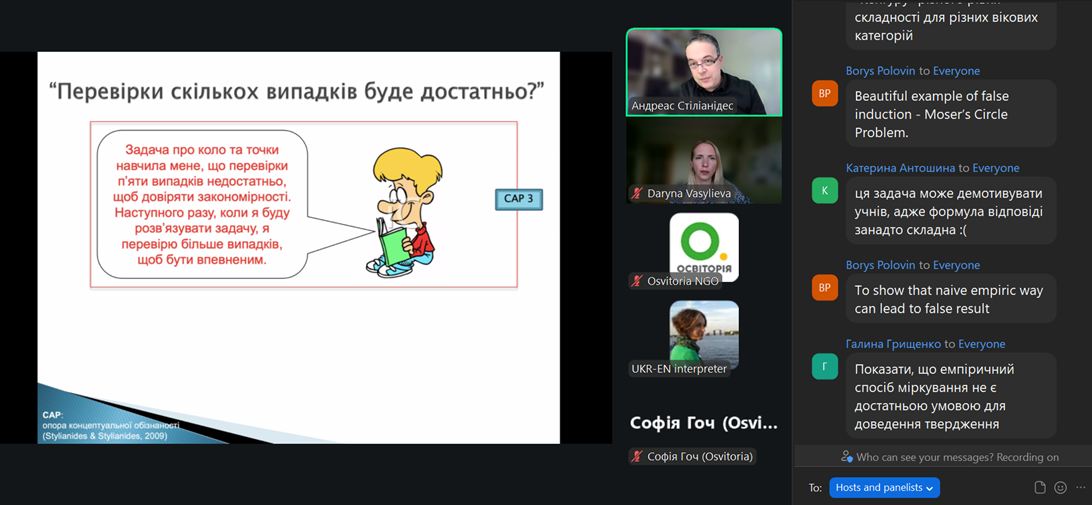
08 травня 2026 року студенти студенти спеціальності «Середня освіта (математика)» (451, 431, 441 групи) відвідали лекцію «Ознайомлення учнів середньої школи з доведеннями в математиці», проведену професором математичної освіти Кембриджського університету. Професор Кембриджського університету Andreas J. Stylianides - відомий у світі дослідник у галузі математичної освіти, чиї наукові праці присвячені розвитку математичного мислення учнів. Були розглянуті питання: Як допомогти учням усвідомити необхідність доведення в математиці? Як поступово сформувати в школярів уміння обґрунтовувати, критично оцінювати, твердження та будувати логічні аргументи?
Особливу увагу було приділено тому, як за допомогою низки спеціально побудованих навчальних ситуацій та когнітивних конфліктів підвести учнів до розуміння потреби доведення. Учасники вебінару ознайомилися з результатами багаторічних досліджень і прикладами навчальних ситуацій, апробованих у школах Великої Британії та США.
Щиро дякуємо професору Андреасу Стіліанідісу за змістовну доповідь.
____________________________________________________
On May 8, 2026, students majoring in “Secondary Education (Mathematics)” (groups 451, 431, and 441) attended a lecture titled “Introducing Secondary School Students to Proofs in Mathematics,” delivered by a professor of mathematics education at the University of Cambridge. Cambridge University Professor Andreas J. Stylianides is a world-renowned researcher in the field of mathematics education, whose scholarly work focuses on the development of students’ mathematical thinking. The following questions were addressed: How can we help students understand the necessity of proof in mathematics? How can we gradually help students develop the ability to justify, critically evaluate, and construct logical arguments?
Particular attention was paid to how a series of specially designed learning situations and cognitive conflicts can lead students to understand the need for proof. Webinar participants were introduced to the results of many years of research and examples of learning situations tested in schools in the UK and the US.
We sincerely thank Professor Andreas Stiliadis for his insightful presentation.